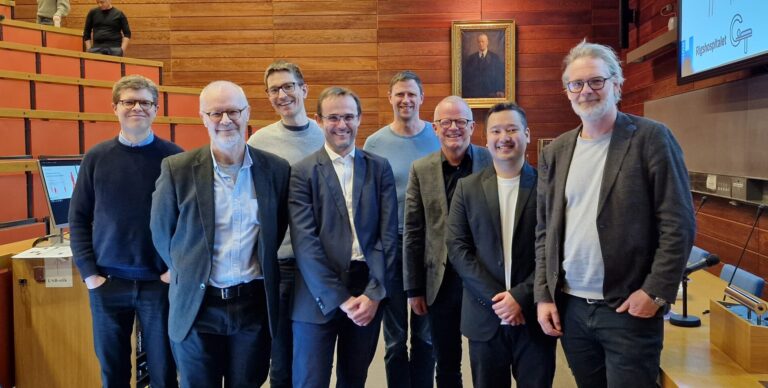
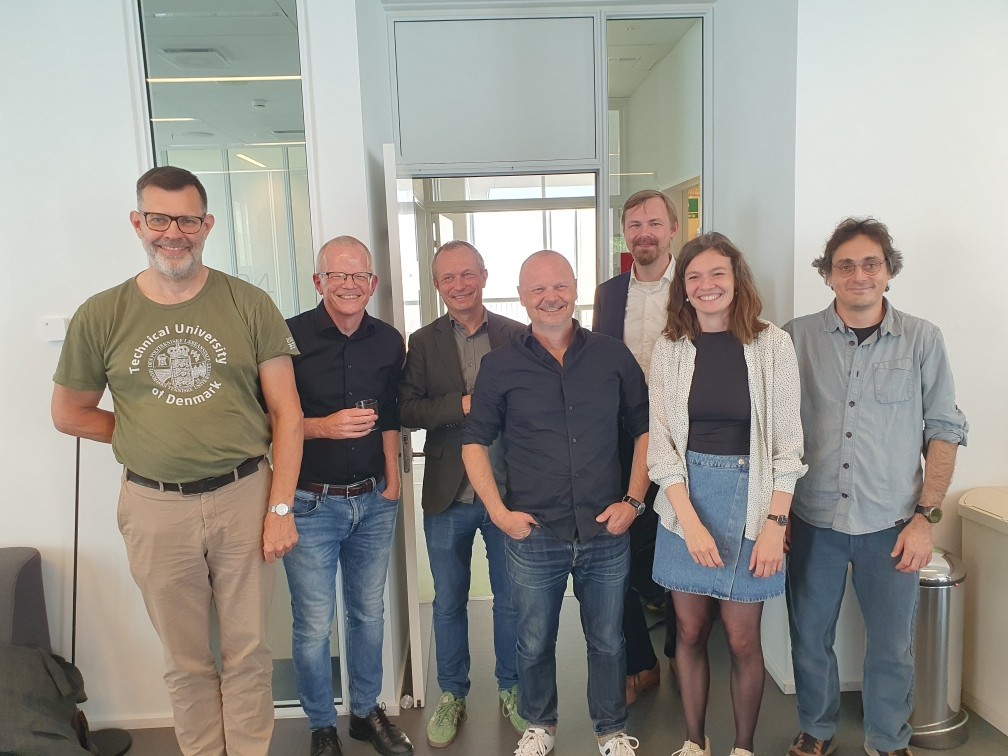
Our engineer researcher PhD-student Kristine Aavild Sørensen from DTU Compute successfully held her PhD defense which took place June 11th 2024 at DTU Compute.
The title of the PhD thesis was “Neural distance field representations with applications in 3D cardiac CT“. This Ph.D. project addresses the need for deriving quantifiable and robust measurements of complex anatomical shapes to characterize the morphology. The developed methods are based on distance fields, where a 3D shape is represented by an implicit function mapping a continuous point in space to a scalar describing the signed or unsigned distance between the point and the nearest point on the surface. We show that this representation can preserve detailed shape information and utilize it to create accurate segmentations of the left atrial appendage from cardiac computed tomography images.
Below you can find a short dialogue with Kristine after successfully defending her PhD – a big congratulations to Kristine!
1) Can you describe the feeling upon completion of your PhD thesis and defence?
It is a feeling of relief and pride. It was a very nice experience to see my research coming together in the thesis and getting to discuss it with some of the best researchers in the field at the defence while colleagues, friends and family were listening.
2) Can you comment on the technical or clinical implications of your research?
The technical contributions from my research have provided automatic and reliable tools for analysing the left atrial appendage. These methods enables studies in LAA shape on larger cohorts with more detailed shape descriptors compared to the currently used clinical measures.
3) What future plans regarding career and research do you have?
I plan to continue doing research in the crossfield of medical image analysis. I will be doing an industrial postdoc with Novo Nordisk in collaboration with Rigshospitalet and DTU, where we will work towards advancing our understanding and treatment options for cardiovascular diseases using AI-based image analysis. I look forward to continuing this collaboration with alot of bright clinical and technical people.